
WASHINGTON, DC—Rachel’s Network announced the awardees of its 2026 Catalyst Award. Now in its eighth year, the Catalyst Award honors women leaders of color for their commitment to a healthy planet, and provides them with financial and leadership support, and public recognition.
Women of color are leading the environmental movement, advocating for clean air and water, building a green economy, fighting polluters, expanding access to healthy food, and much more. Despite this critical work, they do not receive adequate funding, support, or recognition for their leadership. Less than 1 percent of foundation giving goes to women and girls of color, and according to Green 2.0, organizations led by people of color receive less than one percent of multiyear operational budget grants.
Rachel’s Network, a nationwide community of women environmental funders, is working to address this disparity. They launched the Catalyst Award in 2019 to shine a light on women of color carrying Rachel Carson’s legacy. Each year for three years, the award provides women environmental leaders of color with a personal prize ($10,000); a well-being stipend ($5,000); and an organizational grant ($10,000, if applicable).
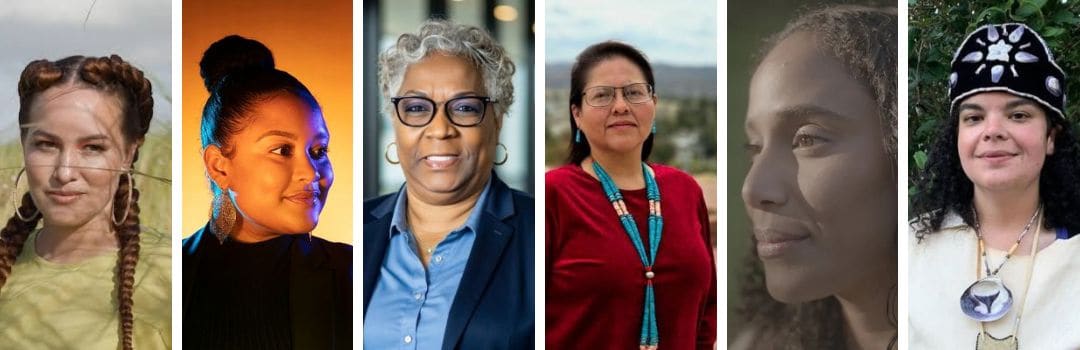
The 2026 awardees have almost a century of experience fighting for our planet and communities. They are scientists, lawyers, storytellers, and organizers. The recipients were selected through a six-month community process. A group of former Catalyst Awardees led the final selection, aligning with participatory grantmaking principles.
The six awardees (in alphabetical order, pictured above) are:
Cara Flores, she/her, Nihi Indigenous Media, Talofofo, Guam
Cara is a Native Chamoru filmmaker whose work maintains that environmental justice in Indigenous homelands must uplift frontline Indigenous voices and knowledge systems. She is a co-founder and director of Nihi Indigenous Media, a nonprofit production house based in Guåhan (Guam) committed to building Indigenous power, community strategic media, and storytelling.
“The dominant narratives about frontline Indigenous communities are often incomplete, distorted, and extractive. At the core of my environmental work is a commitment to return narrative and storytelling agency to our homelands.” – Cara Flores
Jasmine Graham, she/they, Mid-Hudson Energy Transition, Kingston, New York
Jasmine is a visionary leader working at the intersection of energy, housing, and economic justice to build a more equitable future. As executive director of Mid-Hudson Energy Transition, Jasmine has led the development of a local, community-centered energy justice model that advances an inclusive clean energy transition across New York’s Hudson Valley.
“I am trying to achieve something specific and non-negotiable: tangible health, wealth, and prosperity for Black people, Indigenous people, people of color, and people with low incomes. Not conceptual progress or trickle-down benefits but actual power.” – Jasmine Graham
Dr. Marsha Jackson, she/her, Southern Sector Rising, Dallas, Texas
Marsha is a community leader, environmental justice advocate, and public servant dedicated to empowering historically underserved communities. She is the founder and executive director of Southern Sector Rising, a nonprofit advancing environmental justice—born from her fight against the illegal dumping of more than 100,000 tons of discarded shingles next to her home.
“I am fighting for a future where zip code no longer determines health outcomes, life expectancy, or access to basic environmental protections. That means not only stopping pollution after it happens but changing the systems that allow it to happen in the first place.” – Marsha Jackson
Teracita Keyanna, she/her, Red Water Pond Road Community Association, Gallup, New Mexico
Terry is a Diné leader, passionate advocate, and dedicated volunteer in her Navajo community with over 20 years of experience in community service work. Born and raised in the Navajo Nation, Terry sits on the executive board for the Red Water Pond Road Community Association, where she has worked tirelessly to hold the Navajo Nation Environmental Protection Agency, the EPA, and the Nuclear Regulatory Commission accountable for ongoing contamination of native lands.
“We need to go back to what our traditions, heritage, and culture have taught us. We should be the ones who care for and take into account of how Mother Earth is being treated.” – Teracita Keyanna
Dr. Suzanne Pierre, she/her, Critical Ecology Lab, Oakland, California
Suzanne is a soil microbial ecologist, biogeochemist, and National Geographic Explorer. She is the founder and executive director of the Critical Ecology Lab, an independent, Black-led Earth science research institute based in Oakland, CA. She is the originator of the field of critical ecology—the empirical study of how colonial and capitalist political economies have reorganized the living Earth, leaving measurable signatures in the biological systems that regulate our climate.
“Climate science only matters if it reaches the people who need it. Climate solutions only last if the science behind them investigates the whole system. Societal transformation can only happen if there is an institution with the independence and the clarity to address both at once.” – Suzanne Pierre
Tela Loretta Troge, Esq., she/her, Shinnecock Kelp Farmers Southampton, New York
Tela is an attorney, Indigenous rights activist, director of the Shinnecock Kelp Farmers, and executive director of the Niamuck Land Trust. For more than a decade, she has fought for tribal sovereignty, and provided legal services to tribal citizens and nations on matters including land rights, civil rights, cultural and natural resources protection, and tribal governance.
“The thing that always keeps me going is my accountability to my community. The Shinnecock Kelp Farmers is a collective and the work means transformative benefits for my people and the next generation, including my own children.” – Tela Loretta Troge
If you’d like to contribute to the Catalyst Award to support women environmental leaders of color, click here. And stay tuned for the opening of the next application cycle in early 2027!
Congratulations to amazing and powerful women leaders! Thank you Rachel’s Network for your leadership, dedication, and support for brilliant women across our nation. ❤️